What does Familiar Faces mean in Forever?
It means the world is designed to put recognizable players in your path again. In episode 1 of the official Forever podcast, around 35:20, the discussion identifies past groups, guildmates and the friends list as social circles players should repeatedly encounter.
Josh Greenfield describes befriending someone early in the beta, then meeting them again across later questing areas. That is a developer's account of a beta experience, not a guarantee that adding a friend produces a meeting every few hours. The useful point is the continuity: a person you helped can become someone you recognize later.
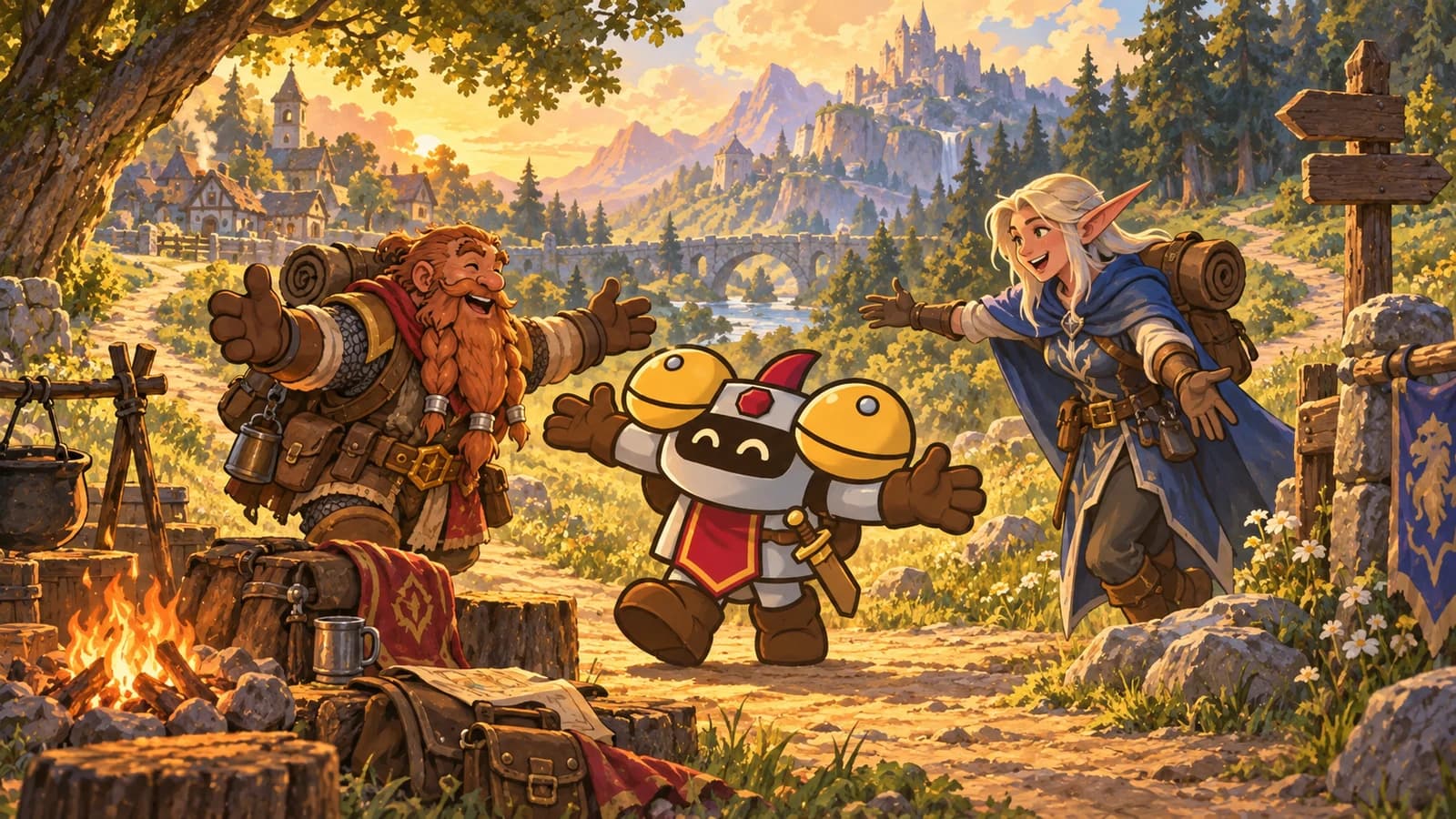
Blizzard's 13 September Deep Dive recap sets the same aim more broadly. A stranger met while questing, gathering or exploring should be able to become a familiar name and then part of a community. Familiar Faces is about that recurring encounter, rather than a replacement for the ordinary act of inviting somebody to a group.
How is this different from Classic's realm community?
Classic's named realm gives players an obvious shared home. Agreeing on the realm is part of agreeing where to start together; recognizing a name can come from spending time among that realm's community. Forever replaces that initial named-realm choice with a ruleset.
That change creates a social question: how does a larger pool of players still feel familiar? Blizzard's answer is to preserve recurring encounters within the larger ecosystem. The podcast describes previous groups and existing social circles as part of that experience, and the official recap frames repeated names as a foundation for community.
Our interpretation is that Forever is trying to preserve the value of a server reputation while changing how players share the world. Whether players actually develop the same lasting relationships is something the live game must demonstrate. A larger population by itself does not prove a stronger community.
What rules still limit playing with friends?
Your friends still need compatible characters. Blizzard's 21 September ruleset guide says parties, dungeons and raids require the same ruleset, and Horde and Alliance cannot group together. A familiar name on your social list does not bypass either restriction.
Normal, PvP and Roleplaying are the launch choices; Hardcore comes later. Existing characters cannot freely change rulesets, so agree on one before creating the characters you intend to play together. Our realmless guide covers the wider transfer and collection rules.
Preferred Online Language also shapes the people you encounter. Blizzard places it under Options, then Languages and Social, and says it applies across the account with a 24-hour cooldown between changes. That is a confirmed social setting; the sources do not say it replaces Familiar Faces or explain how the two are weighted against each other.
Is Familiar Faces the same as party layering?
No. The first is the social goal of recurring encounters. The second concerns which world instance a player occupies when a group is formed or changed. The terms can come up in the same conversation because you only see nearby players who share your current copy of the world.
Blizzard's 1 October beta notes adjusted party changes so the leader should no longer transfer to a different world instance when forming or changing the party. That specific fix does not describe the Familiar Faces algorithm, nor promise that every other member stays in place.
If a friend appears, disappears or needs an invite to meet you, that moment alone does not establish whether Familiar Faces is working correctly. Record the location, group change and what each player could see before drawing a conclusion. Our party-layer guide addresses that narrower beta behavior.
How to approach Familiar Faces as a player
Keep using the social habits you value in Classic. Group with someone when a quest goes better together, add a friend when you want to play again, and make plans with guildmates. These are practical recommendations, not a formula for manipulating placement or a claim about hidden priority values.
The interesting change is what happens between planned sessions. A past dungeon companion might become a recognizable questing neighbor, giving you a natural opening to talk or group again. That is the kind of continuity the developers describe, even though the detailed placement rules remain unpublished.
For Classic players, the question to watch is whether those returning names lead to real relationships over time. A pleasant beta anecdote supports the concept; it cannot settle how reliably the feature will behave at launch, across a large guild or during a crowded event.
Still to come
Not yet settled by our sources or tested in game:
- Published details on how previous groups, friends and guilds affect placement, including any limits or priority rules.
- How long earlier encounters remain relevant and how the system handles conflicting social circles.
- Launch evidence for recurring encounters and how they interact with busy-zone capacity and party transfers.
Sources
Beta notes are dated because Forever is still changing.
- Official Forever podcast episode 1, 24 September 2026 — 35:20Familiar Faces discussion: repeated encounters with previous groups, guildmates and friends; a developer describes a recurring beta acquaintance. Zone-specific capacity discussion starts around 34:48. Timestamped automatic captions checked; no exact quote depends on them.
- Blizzard: Deep Dive Panel Recap, 13 September 2026Realmless ecosystems, recurring names as a foundation for community, grouping boundaries and recognizable player identity. Read 10 October.
- Blizzard: Choose Your Ruleset, 21 September 2026Same-ruleset and same-faction grouping, limited ruleset movement, post-launch Hardcore and account-wide Preferred Online Language with a 24-hour cooldown. Read 10 October.
- Blizzard: Beta Development Notes, 1 October 2026Party leaders should no longer transfer world instance when forming or changing a party; this is distinct from the Familiar Faces social goal. Read 10 October.